H30年度の[1.1],[1.2],[3.1]のみしか解いていないです。空き時間に解きたいです。計算ミスしていたらコメントにて教えて欲しいです…
物理学[I]
1.1 平面の2質点

より、
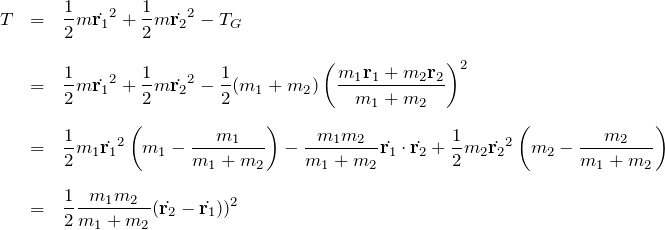
よって、換算質量  :
:
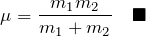
 と置いて、
と置いて、

よって、
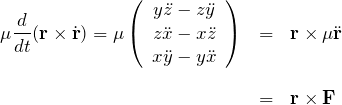
 は 2質点の間の引力で平面内にあるため、 と
  は同一平面内にあるため
  である。
である。
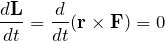
となり、角運動量ベクトル  は時間によらず一定である。よって、 は平面内にとどまり続ける。
運動エネルギー  を求める。極座標表示、
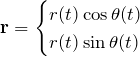
を導入する。 の時間微分は、
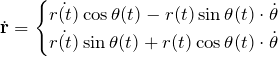
である。以降、 と時間依存性を省略する。運動エネルギー は、
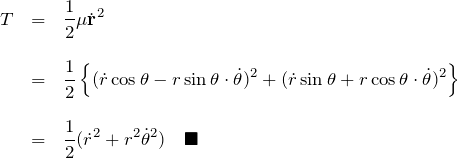
次にポテンシャルエネルギー  を求める。
を求める。
2質点にはたらく引力 の大きさは  は2質点の距離
  に比例する。したがって、

である。よって、

となる(バネの復元力と弾性エネルギーと同じ関係)。
以上よりラグランジアン  は、
は、

であり、 に共役な運動量
  は、
は、
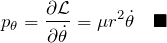
となる。
ここで、上記のラグランジアンを用いてオイラーラグランジュ方程式より、
![\begin{eqnarray*} &&\frac{d}{dt}\textcolor{red}{\frac{\partial {\mathcal L}}{\partial \dot{\theta}}} =\frac{\partial {\mathcal L}}{\partial \theta}\\\\ &&\Leftrightarrow \frac{d\textcolor{red}{p_{\theta}}}{dt} =\frac{\partial}{\partial \theta}\left[ \frac{1}{2}(\dot{r}^2 +r^2\dot{\theta}^2)-\frac{1}{2}kr^2 \right]=0 \end{eqnarray*}](https://batapara.com/wp-content/ql-cache/quicklatex.com-c32039621e8435bd03da81cc9a34bc7c_l3.png "Rendered by QuickLaTeX.com")
となり、 は時間によらず一定であることがわかる。
[?]
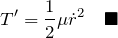
1次元運動で考えたときの運動エネルギー  は
は
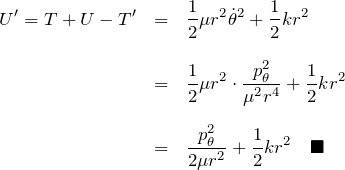
ポテンシャルエネルギー  は
は
これ以降準備中。
1.2 慣性モーメント
2.1 電場・磁場
[準備中]
2.2 電磁波
[準備中]
3.1 井戸型ポテンシャル
3.2 角運動量
これの解答は簡単に。
 : 主量子数、
 :方位量子数、
 :磁気量子数
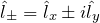
より、
![\begin{eqnarray*} \hat{l}_+\hat{l}_-&=& (\hat{l}_x + i\hat{l}_y)(\hat{l}_x - i\hat{l}_y)\\\\ &=& \hat{l}_x^2-i\hat{l}_x\hat{l}_y+i\hat{l}_y\hat{l}_x+\hat{l}_y^2\\\\\\ \hat{l}_-\hat{l}_+&=& (\hat{l}_x - i\hat{l}_y)(\hat{l}_x + i\hat{l}_y)\\\\ &=& \hat{l}_x^2+i\hat{l}_x\hat{l}_y-i\hat{l}_y\hat{l}_x+\hat{l}_y^2\\\\\\ \therefore \hat{l}_x^2+\hat{l}_y^2&=& \frac{1}{2}\left[\hat{l}_+\hat{l}_- + \hat{l}_-\hat{l}_+ \right]\quad\blacksquare \end{eqnarray*}](https://batapara.com/wp-content/ql-cache/quicklatex.com-4c4269291699cac4e87682c5b5c0eae3_l3.png "Rendered by QuickLaTeX.com")
これより、 について
について
![\begin{eqnarray*} \hat{l}^2&=&\hat{l}_x^2+\hat{l}_y^2+\hat{l}_z^2\\\\ &=&\frac{1}{2}\left[\hat{l}_+\hat{l}_- + \hat{l}_-\hat{l}_+ \right]+\hat{l}_z^2 \end{eqnarray*}](https://batapara.com/wp-content/ql-cache/quicklatex.com-2ac75067a167ae46282c18d8bb17e91e_l3.png "Rendered by QuickLaTeX.com")
である。これを 球面調和関数  に作用させる。

第一項:
![\begin{eqnarray*} \frac{1}{2}\hat{l}_+\hat{l}_- Y_l^m(\theta,\phi) &=& \frac{1}{2}\hat{l}_+ \left[\hbar\sqrt{(l-m)(l+m+1)}Y_l^{m+1}(\theta,\phi) } \right]\\\\ &=& \frac{\hbar}{2} \sqrt{(l-m)(l+m+1)} \hat{l}_+ Y_l^{m+1}(\theta,\phi) \\\\ &=& \frac{\hbar^2}{2}(l-m)(l+m+1)Y_l^m(\theta,\phi) \end{eqnarray*}](https://batapara.com/wp-content/ql-cache/quicklatex.com-797ff270718dfbc2d1bb57026abdb2ba_l3.png "Rendered by QuickLaTeX.com")
第二項:

第三項:

である。ここで、

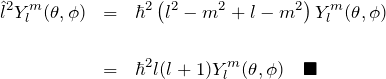
である。したがって、第一項から第三項までを足して、
これ以降については[準備中]
4.1 分配関数
[準備中]
参考になりました!
ありがとうございます!